
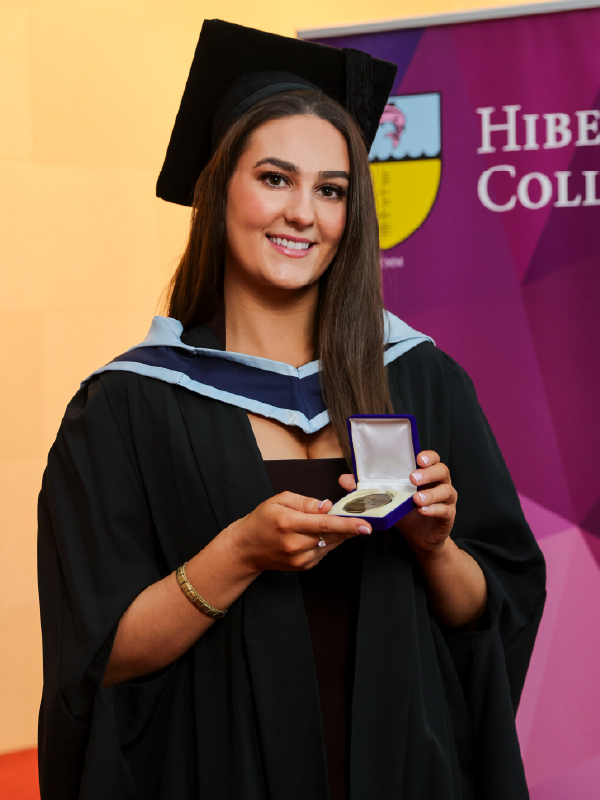
Alumni profile
Katie O’Flaherty
Location
Co. Tipperary.
School
Borrisokane Community College
Education
Bachelor of Arts in German and Geography, Mary Immaculate College
Awards
PMEPP Outstanding Performance in School Experience and Professional Practice Prize
Why did you choose teaching and why Hibernia College?
From an early age, I was passionate about education and the idea of helping young people reach their full potential. Teaching allows me to make a meaningful difference – not only in students’ academic progress but also in their confidence, social development, and sense of belonging. I find great fulfilment in creating inclusive classrooms where every student feels valued and supported. Teaching is a very rewarding, enjoyable career where no two days are the same.
I chose Hibernia College because its blended learning model offered the flexibility to balance study with professional commitments. What drew me most to the programme was its focus on reflective practice, inclusivity, and evidence-based teaching – all of which aligned perfectly with my own teaching philosophy. The support from tutors and the high standard of academic guidance confirmed that Hibernia was the right choice for me.
What field of work or study were you in before you started your PME?
Before beginning my PME, I completed a Bachelor of Arts in German and Geography at Mary Immaculate College, where I developed a deep appreciation for language, culture, and the interconnectedness of people and places. Through my studies, I gained strong analytical and communication skills, along with an understanding of how global citizenship and intercultural awareness can be brought into the classroom to enrich students’ learning experiences.
I also completed a TEFL certification, which gave me the opportunity to teach English as a foreign language in summer camps. This experience strengthened my ability to differentiate lessons, manage mixed-ability groups, and foster confidence in learners of varying backgrounds – all skills that have proven invaluable in the post-primary classroom.
Alongside my studies, I worked in a variety of education-related and customer service roles, including substitute teaching, youth coaching, and hospitality work. These experiences taught me adaptability, empathy, and how to build strong relationships with people from diverse walks of life. Working with young people in both sporting and academic settings confirmed my passion for education and my desire to create inclusive, engaging environments where every student can thrive.
Can you tell us a bit about your research project and why you focused on this area?
My dissertation, titled “Fostering Inclusive Classrooms through Cooperative Learning in Post-Primary Education,” explored how structured group learning can support inclusivity and engagement among diverse learners. I chose this topic because, during my school placements, I saw first-hand how cooperative learning empowered students of all abilities to collaborate, build confidence, and develop empathy.
The research examined teachers’ perceptions of the benefits and challenges of implementing cooperative learning, particularly in DEIS schools. Findings showed that these strategies enhance academic performance, social inclusion, and emotional wellbeing – when supported by effective planning, resources, and professional development. I was motivated by a desire to understand how inclusive practices like cooperative learning can remove barriers to participation and create equitable classroom environments.
Now that you have graduated, what are your plans?
Having completed the PME, my main goal is to continue developing as a reflective and innovative educator. I am currently teaching at Borrisokane Community College, where I strive to create an inclusive and supportive learning environment that enables all students to reach their full potential. My immediate focus is on building upon my research in cooperative learning by incorporating more collaborative, student-led activities into my lessons – encouraging teamwork, peer support, and a sense of belonging in the classroom.
I am particularly passionate about inclusive education, and I plan to continue developing my expertise in this area through professional development in special educational needs (SEN) and digital learning integration. Using educational technology to differentiate instruction and make learning more accessible has become an important part of my teaching approach.
In the long term, I hope to take on leadership roles within the school community, contributing to curriculum planning, inclusion initiatives, and teacher collaboration. I am also interested in mentoring student teachers in the future, sharing my experiences and helping to foster the same sense of passion and purpose that I developed during my PME. Teaching, to me, is a lifelong journey of learning – one that constantly evolves with each student, classroom, and experience.
What piece of advice would you give to any person considering starting a PME?
The PME is both a challenge and a privilege – it will test your resilience, but it will also reaffirm your love for teaching in ways you never expected. My advice to anyone starting the course is to immerse yourself fully in the process: every placement, seminar, and reflective journal is an opportunity to discover your teaching identity.
Teaching is about people not perfection. Therefore, be open to learning from your students as much as from your tutors and cooperating teachers. Some of my most valuable lessons came from observing how different students engage, communicate, and overcome challenges. Those moments remind you why teaching is so meaningful.
Organisation and balance are key, but so is connection. Lean on your peers, because the friendships and support network you build through Hibernia will carry you through the demanding parts of the course and into your professional life. Finally, choose a research topic that genuinely reflects your passion. For me, that was cooperative learning and inclusivity. It allowed me to link theory to real classroom practice, deepening my understanding of how collaboration can transform student engagement.
If you approach the PME with curiosity, empathy, and commitment, it will not only qualify you as a teacher but it will shape you into one who truly makes a difference.
